City centre · free walk
Via Toledo, Galleria Umberto I and Piazza del Plebiscito: a walking guide
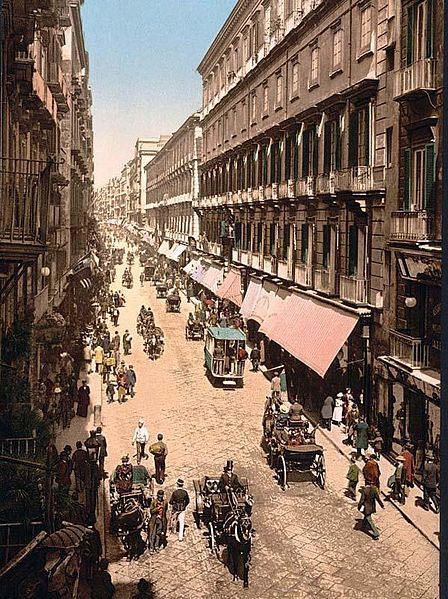
Via Toledo is the street Naples goes to shop and stroll: it starts at Piazza Dante and runs about 1.2 km down to Piazza Trieste e Trento, a step from Piazza del Plebiscito. Along the way you will find what is often called the most beautiful metro station in Europe, a Caravaggio you can see for €8 and the Galleria Umberto I under its glass dome. Via Toledo and the Galleria Umberto are free, and so is Piazza del Plebiscito. This guide covers what to see, what the few paid sights cost and how to plan the walk in half a day.
- Via ToledoAbout 1.2 km, Piazza Dante to Trieste e Trento
- Galleria & PlebiscitoFree entry
- MetroDante, Toledo, Municipio (L1)
- Gallerie d’Italia€8 · free under 26
See tickets
Which ticket to choose
| Option | Best for | from | Note |
|---|---|---|---|
| Via Toledo, Galleria Umberto I and Piazza del Plebiscito | Everyone: these are public spaces | Free | No ticket needed. Night gates are planned for the Galleria, so check it is open if you pass late. |
| Toledo metro station | Visitors who want to see the “art station” | Metro ticket | No special entry: an ordinary travel ticket is enough. Fares are on our getting-around page. |
| Gallerie d’Italia (official ticket) | Visitors who want to see Caravaggio’s Martyrdom of Saint Ursula | €8 | Reduced €4, free under 26 and on the first Sunday of the month. Closed Monday. |
| City Sightseeing Naples hop-on hop-off (Tiqets) | Visitors who want the centre and seafront without much walking | €27 | 24-hour ticket on two lines, same starting price as the official site. Rated 4.3/5 from more than 400 reviews. |
| Spanish Quarter underground tour (Tiqets) | Visitors who want to add an hour underground to the walk | €18 | Starts from Vico Sant’Anna di Palazzo, a few minutes from Via Toledo. About 1 hour, in English or Italian. |
Compare prices
| Offer | from | |
|---|---|---|
| All Naples attraction tickets Tiqets | €10 | Book on Tiqets |
| City Sightseeing Naples: hop on hop off Tiqets · 4.3/5 (416) | €27 | Book on Tiqets |
“From” prices are indicative; the final price is the one shown at checkout.
Via Toledo: the viceroy’s street
Via Toledo was laid out in 1536 by the Spanish viceroy Pedro de Toledo, with the architect Ferdinando Manlio, as a new main axis outside the old city walls. It runs for about 1.2 km from Piazza Dante to Piazza Trieste e Trento, next to Piazza del Plebiscito. From 1870 to 1980 its official name was Via Roma.
Above the street, in the same years, the Spanish Quarter was built, and dozens of its steep alleys open onto Via Toledo. Along the street itself stand noble palazzi and historic bank buildings. Today it is the city’s main shopping street and promenade.
One practical point: it is not all pedestrianised. The car-free stretch runs from Via Armando Diaz to Piazza Trieste e Trento; the upper part, towards Piazza Dante, still has cars and scooters.
Gallerie d’Italia: the Caravaggio on Via Toledo
The only paid entrance on the street is worth the stop. The Gallerie d’Italia – Napoli, Intesa Sanpaolo’s museum at Via Toledo 177, fills the former Banco di Napoli building and holds Caravaggio’s Martyrdom of Saint Ursula (1610), regarded as his last masterpiece.
- Hours: Tuesday–Friday 10:00–19:00, Saturday and Sunday 10:00–20:00, closed Monday. Last entry one hour before closing.
- Prices: full €8; reduced €4 (over-65s, holders of some Artecard passes); free for under-26s, adult holders of the Artecard Napoli 3 and Campania 3-day passes, disabled visitors plus one companion, teachers and some other categories.
- Free for everyone on the first Sunday of every month. In autumn 2026 there are also free openings on Saturday 10 October (AMACI day), Sunday 11 October (F@Mu) and Saturday 24 October (ABI’s “è cultura!”).
Toledo station: a metro stop that is also a work of art
Toledo station on Line 1 opened in 2012. It is one of Naples’ “art stations” and was named the most beautiful in Europe by the Daily Telegraph. Designed by the architect Óscar Tusquets Blanca, it goes down about 44 metres. Its awards include the Emirates LEAF Award 2013 and the ITA Tunnelling Award 2015.
- The water theme: walls clad in blue mosaic, the great cone of light above the escalators and Robert Wilson’s “sea” gallery, with lighting that recalls waves.
- William Kentridge created two large mosaics and the Corten steel sculpture Il Cavaliere di Toledo.
- Oliviero Toscani made the portrait photographs along the corridor to Montecalvario; Achille Cevoli photographed the construction works.
Excavations turned up Aragonese fortifications, 2nd-century Roman bath structures and Neolithic pottery. There are three exits: Via Toledo, Via Diaz and Largo Montecalvario, inside the Spanish Quarter, through a 170-metre corridor. A metro ticket is all you need to see it: the best view is from the escalator, looking up into the blue cone.
Galleria Umberto I: iron, glass and mosaics
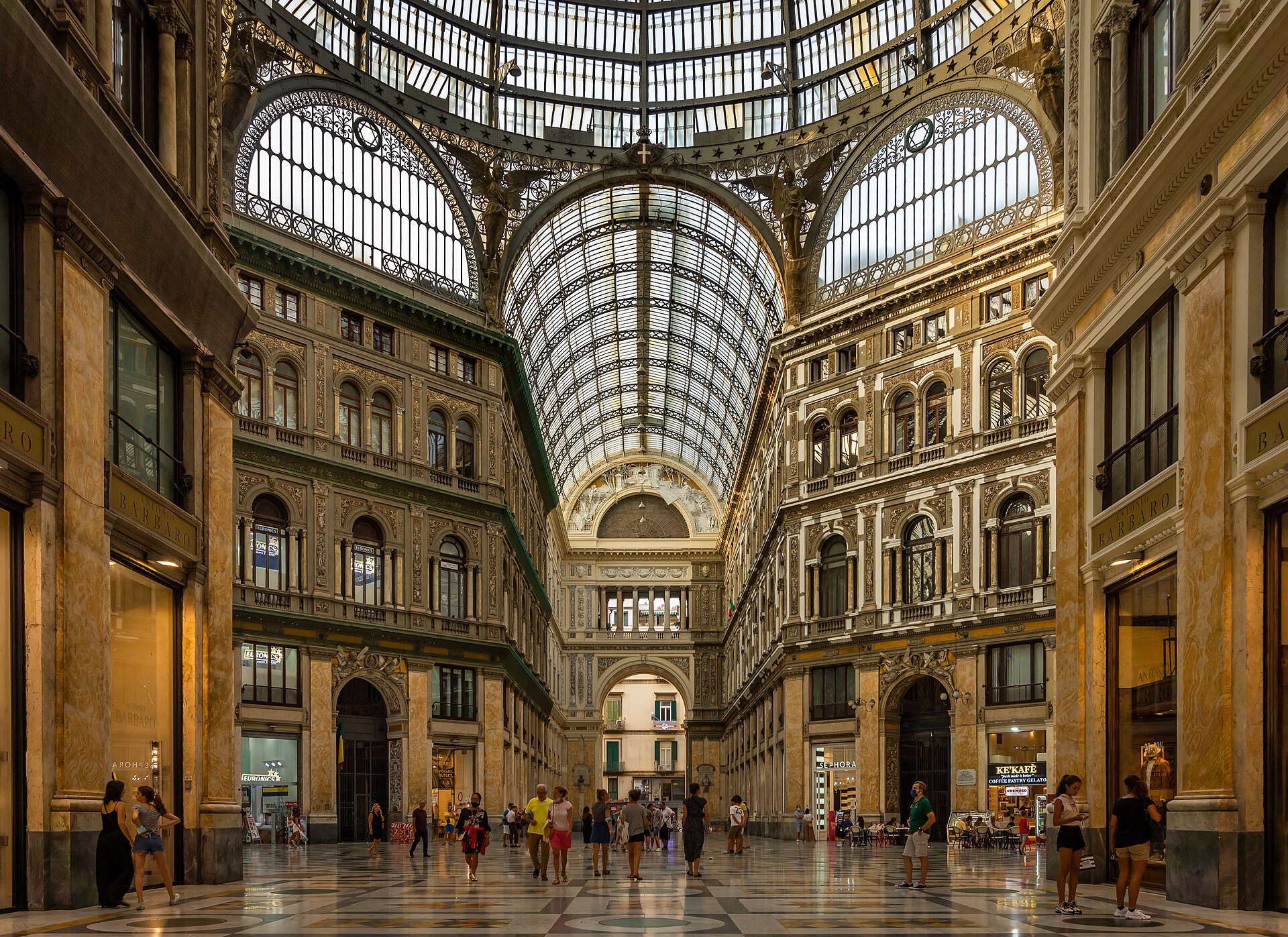
Opposite the Teatro San Carlo, the Galleria Umberto I is the great covered drawing room of late 19th-century Naples. The first stone was laid on 5 November 1887 and it opened on 19 November 1890. It was designed by Emanuele Rocco and developed by Antonio Curri and Ernesto Di Mauro, with the iron-and-glass roof by Paolo Boubée.
- The dome rises to 57 metres on 16 metal ribs, over a cross-shaped plan with four glazed wings.
- Under the dome, the mosaic floor with the signs of the zodiac and the winds is by the Venetian firm Padoan (1952), replacing the original, which had been worn down and damaged in the war.
- The basement holds the Salone Margherita, a Belle Époque café-chantant.
The Galleria is part of the UNESCO-listed historic centre, and the American writer John Horne Burns set his novel The Gallery (1947) here. It is a public passage and free. The city has allocated about €880,000 for decorative gates at the Via Verdi and Via Santa Brigida entrances and for night-time security, and a resident has appealed to the regional administrative court. Until that is settled, bear in mind it may be closed at night.
Piazza del Plebiscito and around
At the bottom of Via Toledo opens Piazza del Plebiscito, about 25,000 m² paved in Vesuvian stone and named after the plebiscite of 21 October 1860 that brought Naples into the Kingdom of Italy.
- On the west side stands the church of San Francesco di Paola by Pietro Bianchi, inaugurated in 1846, modelled on the Pantheon, with a 53-metre dome and a sweeping semicircular colonnade.
- In front are the equestrian statues of Charles of Bourbon, by Antonio Canova, and of Ferdinand I, begun by Canova and completed by Antonio Calì.
- On the east side is the Royal Palace, a state museum (full ticket €15, closed Wednesday), flanked by the twin Palazzo della Prefettura and Palazzo Salerno.
Few people remember that from 1963 to 1994 the square was a car park: it was cleared for the G7 summit and has hosted the city’s big concerts ever since. The Teatro San Carlo is steps away and runs guided tours of about 30 minutes, sold only by the theatre. From here you are a few minutes from the seafront and Castel dell’Ovo.
Our suggested walk, from Piazza Dante to the sea
Walk it downhill. A half-day route:
- Piazza Dante (Dante metro): start at the northern end of Via Toledo. If you have time, detour first into the old town to Santa Chiara, a few minutes’ walk away.
- Upper Via Toledo: shops, palazzi and the first alleys of the Spanish Quarter on your right.
- Toledo station: ride the escalators down to see the blue cone, then come back up.
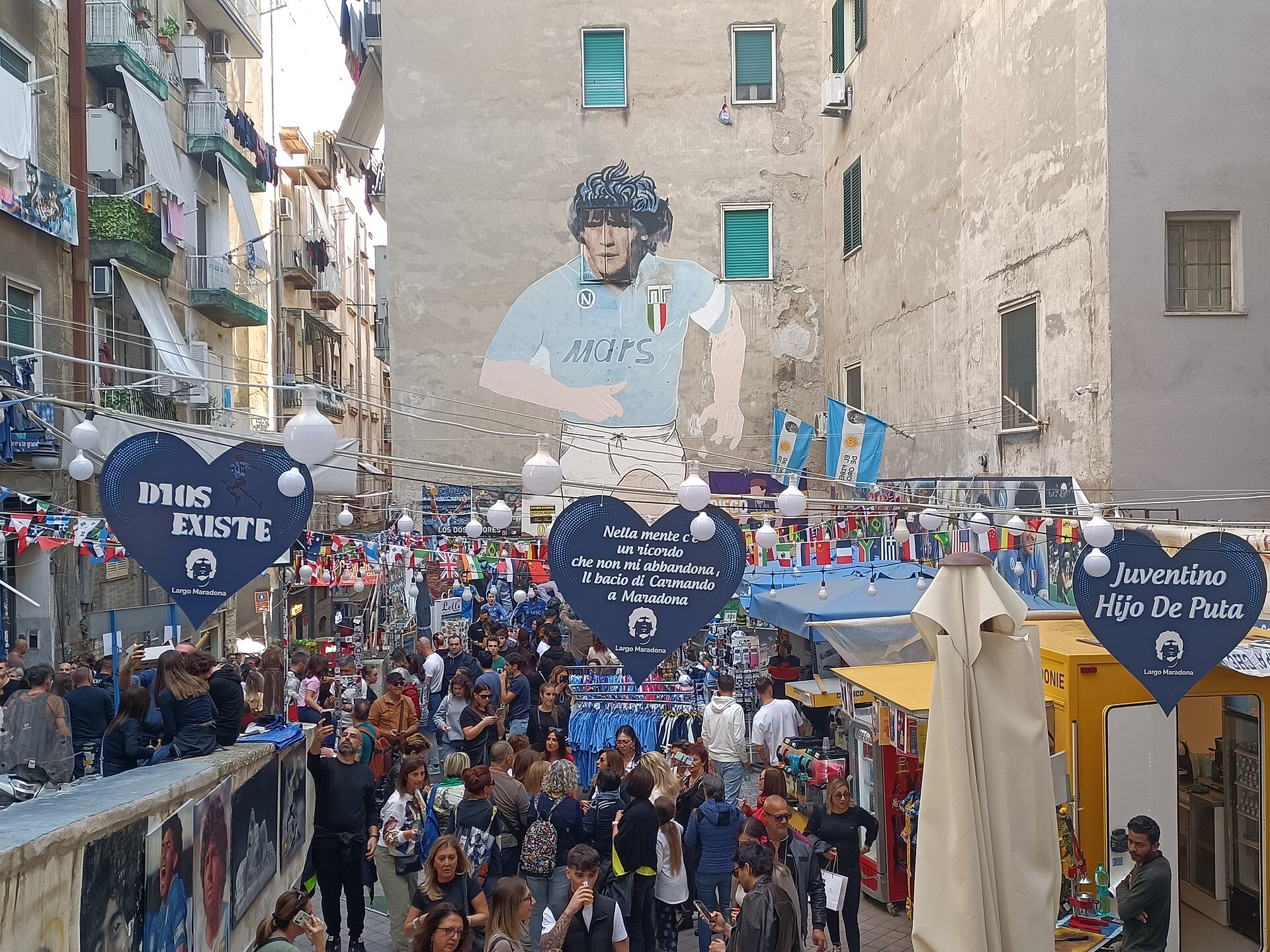
- Spanish Quarter: a 30–60 minute detour to Largo Maradona, or the underground tour from Vico Sant’Anna di Palazzo.
- Gallerie d’Italia: half an hour for the Caravaggio (not on Mondays).
- Galleria Umberto I and the Teatro San Carlo.
- Piazza del Plebiscito and, if you want a museum, the Royal Palace.
Finish on the seafront at sunset, or with a food tour if you want to try the street food with a guide.
Tickets and tours around Via Toledo and the Galleria Umberto
Via Toledo and the Galleria Umberto need no tickets, and most of the walk costs nothing. The sensible spends are few: €8 for the Gallerie d’Italia (nothing if you are under 26), a museum such as the Royal Palace, and perhaps the underground tour in the alleys next door.
If you would rather not walk, the City Sightseeing hop-on hop-off bus leaves from Largo Castello in Piazza Municipio, a few minutes from the Galleria: on Tiqets it costs from €27, the same as the official site, for 24 hours on two lines (historic centre and bay). The Spanish Quarter underground tour is €18 online. For every other sight, start from our Naples tickets page, and for the metro and funiculars see getting around Naples.
We are an independent guide: if you book through the Tiqets links on this page we may earn a commission, at no extra cost to you.
Official sources
Photos
FAQ
Is Via Toledo fully pedestrianised?
No. The stretch between Via Armando Diaz and Piazza Trieste e Trento is pedestrian, closed to traffic since the metro station opened in 2012. The upper part, towards Piazza Dante, still has cars and scooters, so take care when crossing.
Do I have to pay to enter the Galleria Umberto I?
No, the Galleria is a public passage and free to enter. The city has set aside funds for decorative gates and night-time security at the entrances, and an appeal has been lodged with the regional administrative court. If you pass late at night, do not assume it will be open.
How do I visit Toledo metro station?
It is a working station, not a museum: all you need is a metro ticket. The best spot is the escalator that runs down beneath the big cone lined with blue mosaic, so look up as you descend. There are no guided visits or special tickets.
Where can I see the Caravaggio on Via Toledo?
At the Gallerie d’Italia, Via Toledo 177, in the former Banco di Napoli building. The Martyrdom of Saint Ursula (1610) is regarded as Caravaggio’s last masterpiece. Tickets cost €8, under-26s go free, and entry is free for everyone on the first Sunday of the month.
How long do Via Toledo, the Galleria and Plebiscito take?
The walk from Piazza Dante to Piazza del Plebiscito takes a couple of hours with stops. Add the Gallerie d’Italia, Toledo station and a visit to the Royal Palace and you are looking at a generous half day.
Which metro stop is best for Via Toledo?
It depends where you want to start. Dante (Line 1) is at the top of the street, Toledo halfway down and Municipio near the southern end, towards the Galleria and the port. For a downhill walk, get off at Dante and head back from Municipio at the end.